MUCH GRACE PUBLICATIONS
MEDIA & PRESS
Everything you need to discover, discuss and share LITTLE CHRISTS.
Warren Wysocki is available for Christian radio, podcasts, interviews, church groups, book groups and Christian media features. This page provides the essential information, images and interview material for producers, presenters, journalists and church leaders.
THE SERIES
LITTLE CHRISTS
A four-book historical fiction series set in the world of first-century Christianity, following ordinary people whose lives become caught up in extraordinary events.

THE STORIES
Read the full synopses
BOOK ONE
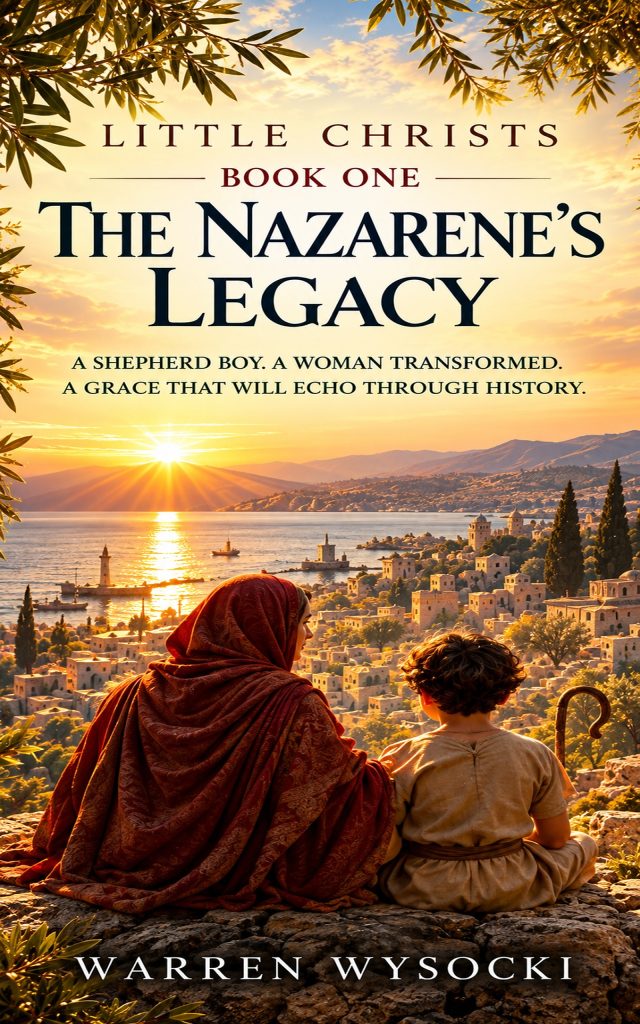
THE NAZARENE’S LEGACY
Mary of Magdala has built a life no one can control. Wealthy, intelligent and fiercely independent, she owns a successful fishing business and has learned to survive a childhood marked by violence, loss and abandonment. Yet one thing remains beyond her control: debilitating seizures that have resisted every physician and treatment she can afford.
Her life changes when she encounters Jesus of Nazareth. During a seizure, Mary collapses in a crowd searching for the healer. Jesus kneels beside her, calls her by name and restores her. His compassion reaches beyond her illness and wealth, leaving Mary confronted by a man she cannot buy, command or understand.
Years later, nine-year-old Karp is struggling to survive the collapse of his own family. After losing his parents and siblings, he is captured and sold into slavery. Brutally treated and eventually abandoned, he is rescued by Christians and brought into Mary’s care.
Mary recognises the brokenness in the boy because she knows it herself. She takes him into her household, where love, Scripture and friendship slowly begin to heal him. Karp, however, is haunted by nightmares and visions that suggest his life has a purpose he cannot yet understand.
Their growing relationship is tested when Karp encounters Áchristós, a mutilated African slave who has been stripped of his identity and family. Karp sacrifices almost everything he owns to secure the man’s freedom. Áchristós reveals that he is actually Prince Yao, betrayed by his uncle and consumed by hatred. He becomes part of Mary’s unconventional household, but his bitterness towards God threatens to destroy the fragile family they are building.
Through Mary, Yao is forced to confront the question that has haunted him since his family was taken from him: why would a loving God allow such suffering? His eventual encounter with Jesus begins a transformation that neither he nor Karp could have anticipated.
As Karp grows, he becomes increasingly involved with the Roman veterans and soldiers surrounding Ephesus. When the notorious pirate Ambroos the Red threatens the city, Karp’s courage and ingenuity draw him into a dangerous plan to capture the pirate and his men. Working alongside those who have become his friends and protectors, Karp helps devise the trap that finally brings Ambroos down.
But the greatest journey is not the one Karp makes across the Mediterranean or into danger. It is the journey from a frightened, traumatised child who needs to understand everything before he can trust anyone, to a young man learning that faith sometimes means following without knowing where the road leads.
The novel unfolds through a present-day frame in Ephesus, where Karp recounts these extraordinary events to Mary. As he tells the stories of his childhood, of Mary, Yao, the Romans and those who followed Jesus, it becomes clear that the legacy of the Nazarene is not merely a story about what happened in the past. It is about what happens when ordinary, damaged people encounter a love powerful enough to change them.
And as Karp finishes his story, a new crisis arrives: his Roman friend Tullius has been seriously injured. Karp knows he must go to him. Mary refuses to let him go alone. Together they step into the darkness — not knowing what awaits them, but trusting that the road ahead is one they are meant to walk.
BOOK TWO
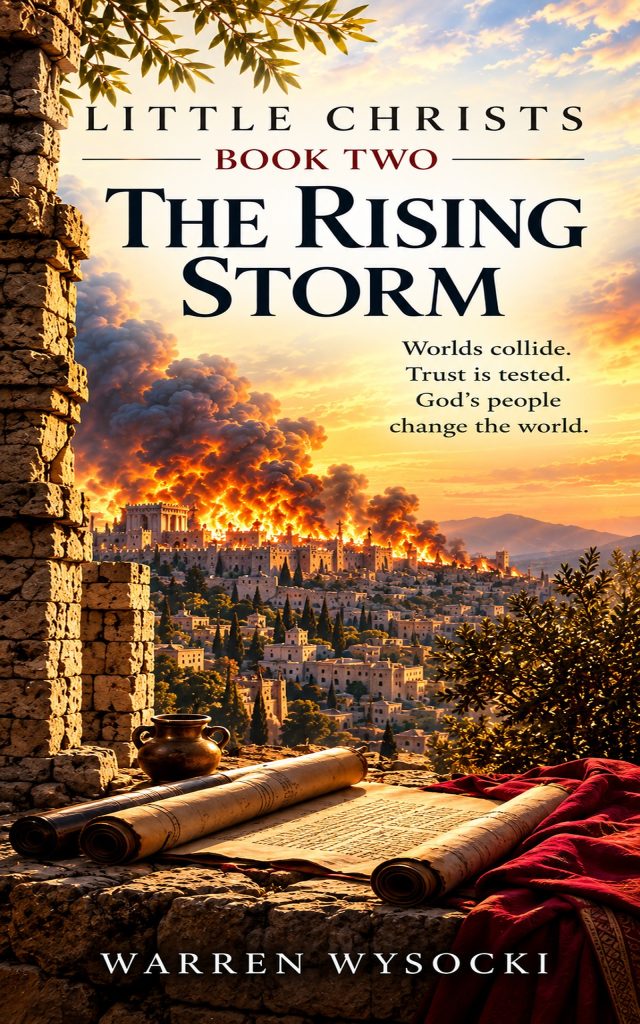
THE RISING STORM
In Ephesus in the summer of AD 81, Karp’s life is already bound up with people whose stories reach far beyond the city. When the historian Flavius Josephus joins the circle around Mary of Magdala, the telling of personal histories opens a window onto a world convulsed by war, ambition and the growing movement of Jesus’ followers. But the past is not safely behind them: Rome still wants answers, and the search for the lost treasure of Jerusalem’s Temple is far from over.
Through Josephus and the people whose lives intersect with his, the story returns to the political and military struggle that culminated in Jerusalem’s destruction. Roman commanders, Jewish leaders and competing factions pursue their own strategies while ordinary people are caught between them. Alliances are fragile, loyalties are tested, and the decisions of generals and rulers carry consequences for families, soldiers and the vulnerable who have little control over their fate.
The campaign unfolds through the perspectives of the historian, the strategist and the general. Behind the public theatre of power lie secret negotiations, spies, tunnels beneath the Temple, shifting loyalties and plans designed to outwit an enemy. Eleazar bar Simon and Shimon bar Giora become central to the struggle within Jerusalem, where resistance to Rome is also undermined by internal division. As the siege tightens, every faction must decide what it is willing to sacrifice — and what it hopes to save.
Sarah’s story brings the cost of the conflict into sharp focus. In a makeshift hospital, suffering continues beyond the battlefield, while the city moves towards catastrophe. Rome watches, the siege becomes destruction, and the Temple and the world surrounding it are changed forever. The novel does not treat the fall of Jerusalem as a distant military episode: it follows the human consequences of a city trapped between imperial force, political ambition and civil war.
Yet the end of the siege does not end the struggle. The quest for the Temple treasure draws Josephus and others into a dangerous search involving Rabbi Yochanan ben Zakkai, hidden knowledge, deception and a kidnapping. Karp becomes caught up in events that are larger and stranger than he understands. His courage and quick thinking matter, but so do the trust he places in others and the friendships that have begun to make him feel that he belongs.
Among the people whose lives converge is Áchristós — Prince Yao — whose history of betrayal and suffering has left him guarded and angry. The growing bonds between Yao, King Agrippa and the others challenge the isolation that pain has built around him. A declaration of shared loyalty and family becomes more than a political gesture: it offers the possibility of belonging where betrayal once seemed to have the final word.
Throughout the novel, Karp is still learning how to live with uncertainty. He wants answers, plans and explanations, but the people he meets show him that courage is not the same as control, and that faith must sometimes act before the whole picture is clear. The story’s great historical upheavals mirror the quieter storms within the characters themselves.
The book closes in Ephesus, but not with every mystery resolved. Josephus receives instructions from Titus to find Nahshon, who has escaped, while a priestess connected with the Temple of Artemis remembers the boy who crossed a boundary she does not understand. A strange voice declares that Karp is marked and that many will return. The danger has not passed; the rising storm is moving into a new phase.
BOOK THREE
THE REVELATION
In Ephesus in AD 81, a gathering of friends becomes the setting for a story that reaches back through royal households, political intrigue and encounters with Jesus Himself. King Agrippa has carried a private burden for years, and as he begins to speak, the people around him discover how closely their own lives are connected to the larger story of God’s work in the world. The past is not merely recalled: its unanswered questions begin to shape what they must do next.
The story follows the royal siblings and the events that formed them, moving through the world of Yeshua of Nazareth, the teachers and seekers who encountered Him, and the dangerous alliances surrounding Rome’s ruling families. Power can secure wealth and influence, but it cannot guarantee love, justice or peace. Marriages become instruments of control, illness threatens a king, and political manoeuvring places vulnerable people in danger. The struggle to rescue a woman who will not bend becomes a test of courage, ingenuity and the willingness to risk comfort for someone else’s freedom.
Alongside the royal story, Áppha John and the people of Ephesus confront troubles of their own. John’s presence brings spiritual depth and hard-won wisdom, while younger men such as Eutychus and Deon wrestle with anger, fear, destructive habits and lives overshadowed by darkness. Their problems are not solved by appearances or easy answers. They must face the truth about themselves and discover what it means to be changed rather than merely to behave differently.
As the different stories converge, the community begins preparing for a gathering that will require far more than organisation. People who have been wounded, divided or burdened by private struggles are drawn towards one another. Natasa’s healing, the lives of Alexander and Naomi, and the preparations made day by day build towards an event that no one can fully anticipate.
Then the unexpected happens: Jesus Himself appears in the physical among His people. The revelation is not simply a spectacle or a confirmation of what the characters already believe. His presence exposes the difference between religious performance and a life shaped by love. People who have carried grief, shame, anger and fear must decide how they will respond when the One they have followed is no longer only the subject of stories and teaching, but is there among them.
The encounter reaches into individual lives. Naomi experiences healing; Mary and Berenice are drawn into the unfolding events; and the community is confronted with the command to love one another in a way that is visible, costly and real. The gathering becomes a turning point, not because every difficulty disappears, but because the people discover that the presence of Jesus changes how they see one another and what they believe is possible.
THE REVELATION continues Karp’s journey from a boy who longs to understand everything into someone learning to trust God amid uncertainty. The stories of rulers, servants, seekers and ordinary believers reveal a common truth: no position, history or wound places a person beyond the reach of grace. What matters is not status or religious display, but the response of a heart confronted by the love of Christ.
By the end, the people of Ephesus have encountered something that cannot be reduced to a tale about the past. The revelation is personal and communal: Jesus is not merely remembered; His presence calls people into a different way of living. The story continues, and the lives changed by that encounter must now carry its consequences into the world beyond their gathering.
BOOK FOUR
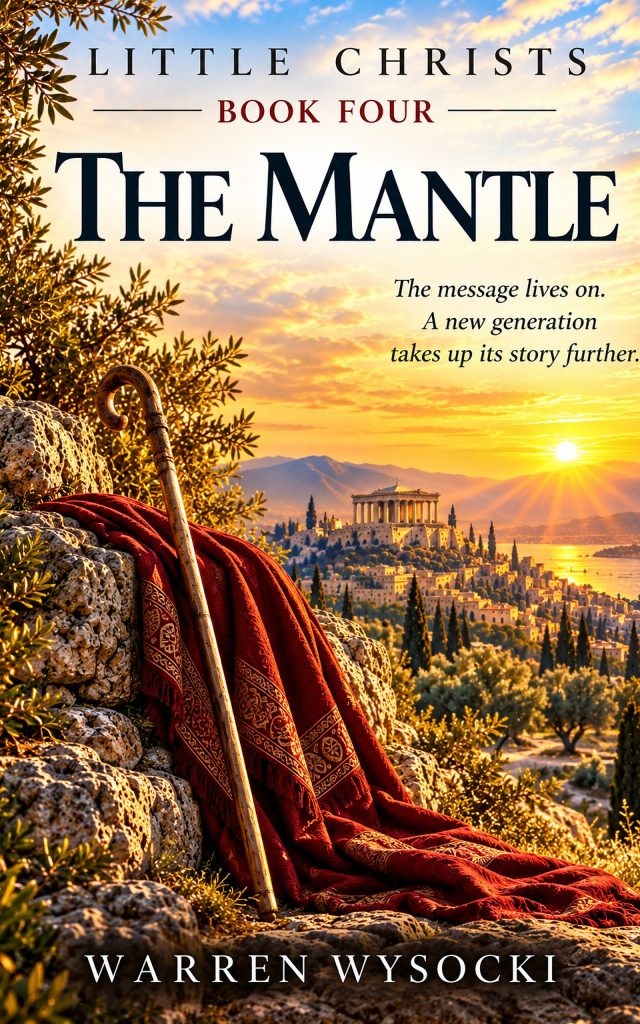
THE MANTLE
THE MANTLE moves across continents and generations, following the people who carry the message of Jesus into a world of imperial power, persecution and spiritual conflict. In AD 95, Karp’s story is still unfolding in Ephesus, but the events that shape the future of the Church reach from the Aegean Sea to India and beyond. Each strand asks the same question: what does it mean to receive the truth, be transformed by it, and pass it on?
On Patmos, Áppha John faces the hostility of Emperor Domitian and the schemes of those who seek to silence him. Accusations, poison, torture and exile threaten to end his witness. Yet even when he is isolated and surrounded by danger, John receives the revelation that will become central to the faith of generations to come. His struggle is not only to survive, but to remain faithful and complete the work entrusted to him.
Far away, Aiguo Jin Sheng’s life is shaped by captivity, displacement and the struggle to hold on to identity. Alongside other enslaved people, he encounters followers of Jesus and experiences a faith that changes how he understands himself and those around him. His journey brings together cultural worlds that seem impossibly distant, revealing how the message of Christ travels through ordinary people, unlikely friendships and acts of courage rather than through the power of empires.
Thomas’s mission carries the story eastwards to India. There he encounters people whose beliefs, loyalties and traditions are deeply rooted, and whose lives are caught up in royal rivalries, danger and the search for spiritual truth. With the help of new companions, Thomas faces attempted murder, political intrigue and the influence of magicians who use fear and deception to control others. His mission is tested repeatedly, but healing, deliverance and unexpected encounters open doors that force people to reconsider what they believe about God.
In Kerala, the young Kunjan, born into a royal family, is drawn into events he cannot explain. His encounters with the Shining Man and the followers of Jesus challenge the world he has been taught to accept. As the story moves through families, rulers, temples and communities, the question of allegiance becomes personal: will people cling to inherited power and fear, or risk trusting the God who calls them into a different life?
Meanwhile, Karp faces renewed persecution and is captured by the Roman Frumentarii. With Tribune Tullius and others drawn into the danger, he must navigate interrogation, political pressure and threats that test both his courage and his growing faith. The return of Josephus and the work of the believers in Ephesus link Karp’s personal struggle to the wider conflict facing the Church. He is no longer simply the frightened boy who needs every question answered; he is being prepared to serve others.
John’s witness reaches its decisive moment as he completes the work given to him and eventually returns to Ephesus. His final preaching and the passing on of the mantle mark a transition: the faith cannot depend on one remarkable person remaining forever. It must be carried by those who have listened, learned and been changed. Karp must face what that responsibility means for him, even as Thomas’s journeys continue to bring healing, reconciliation and new believers into the story.
Across the different lands, the lives of Aiguo, Thomas, Kunjan, John and Karp converge around the same truth. The message of Jesus crosses languages, borders, social divisions and generations, often carried by people with little worldly power. The cost is real: persecution, loss, danger and uncertainty remain. Yet so do courage, compassion, miracles and the possibility of reconciliation where hatred once ruled.
By the end, Karp has completed a second circuit of the seven Churches and begins to understand that his calling is not simply a task he must decipher. He embraces the name Polykarpos — the fruitful one — and recognises that he has spent years asking God what He wanted him to do without asking what God wanted to do with him. The mantle is not a prize or a position; it is a life transformed and offered in service. The series closes with Karp finally understanding that the work of Christ continues as ordinary people are changed and then carry that change to others.
BOOK TWO
THE RISING STORM
Worlds collide. Trust is tested. God’s people change the world.
BOOK THREE
THE REVELATION
Darkness gives way to light. The story continues.
BOOK FOUR
THE MANTLE
The message lives on. A new generation takes up its story further.