LITTLE CHRISTS · BOOK TWO
THE RISING STORM
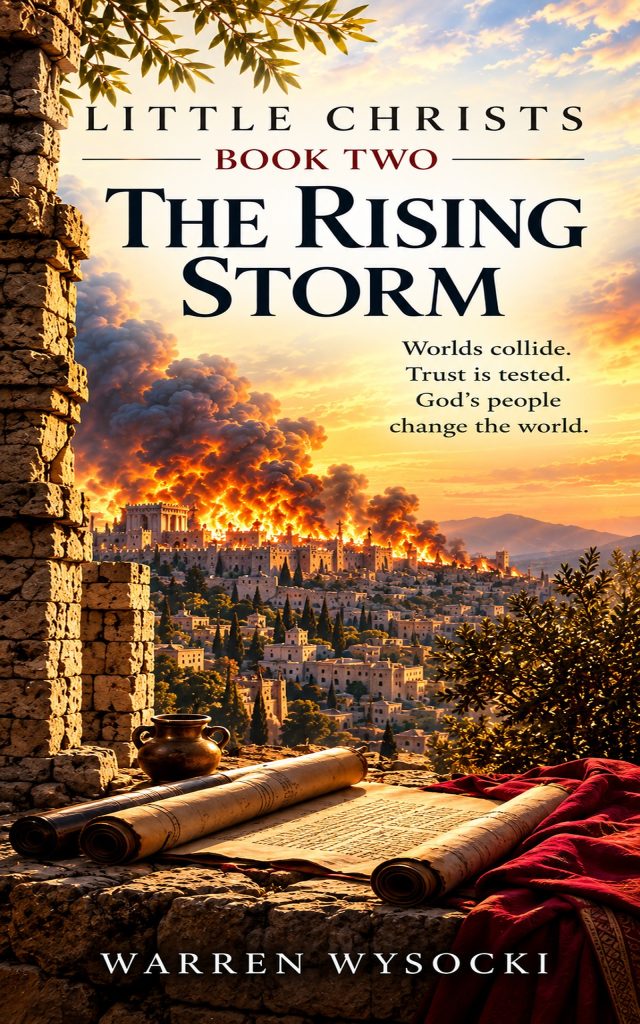
Worlds collide. Trust is tested. God’s people change the world.
Full Synopsis
In Ephesus in the summer of AD 81, Karp’s life is already bound up with people whose stories reach far beyond the city. When the historian Flavius Josephus joins the circle around Mary of Magdala, the telling of personal histories opens a window onto a world convulsed by war, ambition and the growing movement of Jesus’ followers. But the past is not safely behind them: Rome still wants answers, and the search for the lost treasure of Jerusalem’s Temple is far from over.
Through Josephus and the people whose lives intersect with his, the story returns to the political and military struggle that culminated in Jerusalem’s destruction. Roman commanders, Jewish leaders and competing factions pursue their own strategies while ordinary people are caught between them. Alliances are fragile, loyalties are tested, and the decisions of generals and rulers carry consequences for families, soldiers and the vulnerable who have little control over their fate.
The campaign unfolds through the perspectives of the historian, the strategist and the general. Behind the public theatre of power lie secret negotiations, spies, tunnels beneath the Temple, shifting loyalties and plans designed to outwit an enemy. Eleazar bar Simon and Shimon bar Giora become central to the struggle within Jerusalem, where resistance to Rome is also undermined by internal division. As the siege tightens, every faction must decide what it is willing to sacrifice — and what it hopes to save.
Sarah’s story brings the cost of the conflict into sharp focus. In a makeshift hospital, suffering continues beyond the battlefield, while the city moves towards catastrophe. Rome watches, the siege becomes destruction, and the Temple and the world surrounding it are changed forever. The novel does not treat the fall of Jerusalem as a distant military episode: it follows the human consequences of a city trapped between imperial force, political ambition and civil war.
Yet the end of the siege does not end the struggle. The quest for the Temple treasure draws Josephus and others into a dangerous search involving Rabbi Yochanan ben Zakkai, hidden knowledge, deception and a kidnapping. Karp becomes caught up in events that are larger and stranger than he understands. His courage and quick thinking matter, but so do the trust he places in others and the friendships that have begun to make him feel that he belongs.
Among the people whose lives converge is Áchristós — Prince Yao — whose history of betrayal and suffering has left him guarded and angry. The growing bonds between Yao, King Agrippa and the others challenge the isolation that pain has built around him. A declaration of shared loyalty and family becomes more than a political gesture: it offers the possibility of belonging where betrayal once seemed to have the final word.
Throughout the novel, Karp is still learning how to live with uncertainty. He wants answers, plans and explanations, but the people he meets show him that courage is not the same as control, and that faith must sometimes act before the whole picture is clear. The story’s great historical upheavals mirror the quieter storms within the characters themselves.
The book closes in Ephesus, but not with every mystery resolved. Josephus receives instructions from Titus to find Nahshon, who has escaped, while a priestess connected with the Temple of Artemis remembers the boy who crossed a boundary she does not understand. A strange voice declares that Karp is marked and that many will return. The danger has not passed; the rising storm is moving into a new phase.
Read an Extract
Ephesus, Asia Minor — Early Summer, 81 A.D.
“You, boy. Come here.”
It was the middle of a sweltering day in Ephesus, and Karp had just arrived at the market with an extra-long shopping list from Mary.
Even beneath the fully extended awnings, the heat was oppressive. Stray dogs had disappeared beneath the porticoes, seeking whatever shade they could find.
Karp wondered who was being summoned.
Then he realised the beckoning arm was pointing directly at him.
He stepped into the sunlight and immediately regretted it. Heat shimmered above the paving stones, making it difficult to see.
Shielding his eyes, he looked towards a magnificent litter carried by four enormous Nubians.
Gold and silver flashed in the sunlight.
“Come here, boy,” called the stranger in Greek. “Don’t worry. I won’t bite you.”
From what he could see of the man’s clothing, he was obviously a noble. But it was the voice that threw him.