LITTLE CHRISTS · BOOK ONE
THE NAZARENE’S LEGACY
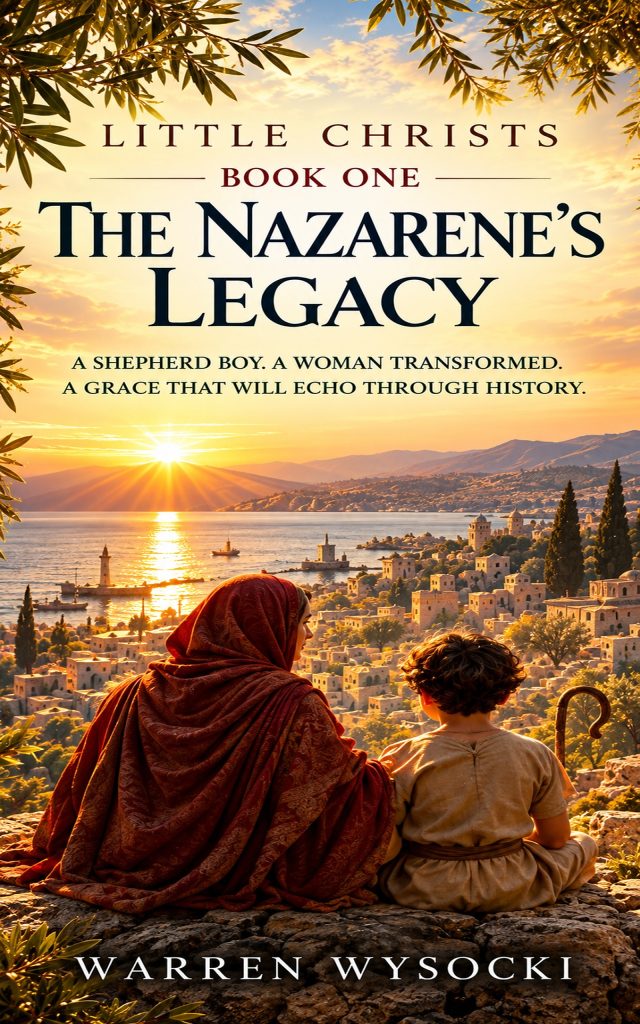
The beginning of the story.
Full Synopsis
Mary of Magdala has built a life no one can control. Wealthy, intelligent and fiercely independent, she owns a successful fishing business and has learned to survive a childhood marked by violence, loss and abandonment. Yet one thing remains beyond her control: debilitating seizures that have resisted every physician and treatment she can afford.
Her life changes when she encounters Jesus of Nazareth. During a seizure, Mary collapses in a crowd searching for the healer. Jesus kneels beside her, calls her by name and restores her. His compassion reaches beyond her illness and wealth, leaving Mary confronted by a man she cannot buy, command or understand.
Years later, nine-year-old Karp is struggling to survive the collapse of his own family. After losing his parents and siblings, he is captured and sold into slavery. Brutally treated and eventually abandoned, he is rescued by Christians and brought into Mary’s care.
Mary recognises the brokenness in the boy because she knows it herself. She takes him into her household, where love, Scripture and friendship slowly begin to heal him. Karp, however, is haunted by nightmares and visions that suggest his life has a purpose he cannot yet understand.
Their growing relationship is tested when Karp encounters Áchristós, a mutilated African slave who has been stripped of his identity and family. Karp sacrifices almost everything he owns to secure the man’s freedom. Áchristós reveals that he is actually Prince Yao, betrayed by his uncle and consumed by hatred. He becomes part of Mary’s unconventional household, but his bitterness towards God threatens to destroy the fragile family they are building.
Through Mary, Yao is forced to confront the question that has haunted him since his family was taken from him: why would a loving God allow such suffering? His eventual encounter with Jesus begins a transformation that neither he nor Karp could have anticipated.
As Karp grows, he becomes increasingly involved with the Roman veterans and soldiers surrounding Ephesus. When the notorious pirate Ambroos the Red threatens the city, Karp’s courage and ingenuity draw him into a dangerous plan to capture the pirate and his men. Working alongside those who have become his friends and protectors, Karp helps devise the trap that finally brings Ambroos down.
But the greatest journey is not the one Karp makes across the Mediterranean or into danger. It is the journey from a frightened, traumatised child who needs to understand everything before he can trust anyone, to a young man learning that faith sometimes means following without knowing where the road leads.
The novel unfolds through a present-day frame in Ephesus, where Karp recounts these extraordinary events to Mary. As he tells the stories of his childhood, of Mary, Yao, the Romans and those who followed Jesus, it becomes clear that the legacy of the Nazarene is not merely a story about what happened in the past. It is about what happens when ordinary, damaged people encounter a love powerful enough to change them.
And as Karp finishes his story, a new crisis arrives: his Roman friend Tullius has been seriously injured. Karp knows he must go to him. Mary refuses to let him go alone. Together they step into the darkness — not knowing what awaits them, but trusting that the road ahead is one they are meant to walk.
Read an Extract
Magdala Nunayya — Galilee — Spring, c. 29 A.D.
Mary turned to leave.
The ground seemed to move beneath her feet.
She reached for Efrayim’s shoulder, but by then she knew what was happening.
Not again.
She had spent years learning to recognise the warning signs — the strange pressure behind her eyes, the distortion of light, the tightening of her muscles.
But this seizure was already upon her.
Then she heard the crowd.
At first it was little more than a distant murmur, but it quickly grew louder. People seemed to be coming from everywhere, converging on the quay and filling the road ahead of her.
Men. Women. Children.
Some were carrying sick relatives. Others leaned heavily on sticks. A blind man was being guided through the crowd, while a woman struggled beneath the weight of a child who appeared barely conscious.
Everyone was moving in the same direction. Everyone was looking for someone.
“What is happening?” she asked.
Efrayim didn’t answer immediately.
Then, quietly, he said, “Jesus.”